
Advanced Search
Submit Manuscript Advanced Search
Submit Manuscript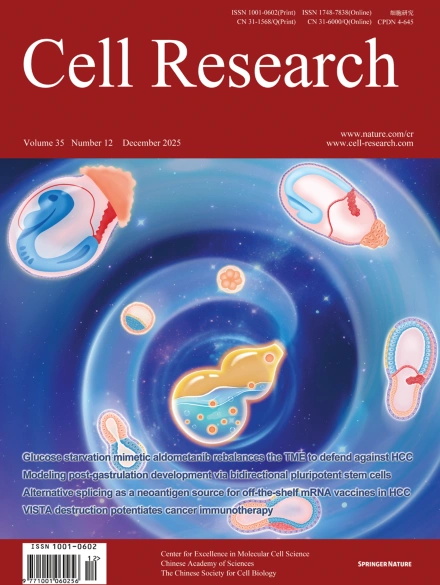
Volume 35, No 12, Dec 2025
ISSN: 1001-0602
EISSN: 1748-7838 2018
impact factor 17.848*
(Clarivate Analytics, 2019)
Volume 35 Issue 12, December 2025: 934-953 |
Glucose starvation mimetic aldometanib removes immune barriers permitting mice with hepatocellular carcinoma to live to normal ages
Hui-Hui Hu1,† , Xuefeng Wang2,† , Bin Lan2,† , Haili Cheng2 , Hong Wen2 , Fangfang Chen2 , Jianfeng Wu3 , Mengqi Li1 , Jiazhou Chen1 , Jinhui Zhang4 , Dongxu Chen1 , Shiyu Lin1 , Jieyu Lin2 , Mingyang Yang1 , Zhenhua Wu1 , Zhong-Zheng Zheng1 , Fuqing Chen5 , Jianyin Zhou5 , Gang Chen2 , Yu Chen2 , Xianming Deng1,6 , Chen-Song Zhang1,4,6,* , Jingfeng Liu2,* , Sheng-Cai Lin1,4,6,*
1State Key Laboratory of Cellular Stress Biology, State-Province Joint Engineering Research Center of Targeted Drugs from Natural Products, School of Life Sciences, Xiamen University, Xiamen, Fujian, ChinaDysregulated metabolism in tumor tissues and para-tumor tissues alike can lead to immunosuppression, which may underlie cancer development. However, metabolic intervention as a therapeutic strategy has been of no avail. In this study, we explored the anti-cancer therapeutic effect of aldometanib, which specifically targets lysosome-associated aldolase to mimic glucose starvation and thereby activates lysosomal AMP-activated protein kinase (AMPK), a master regulator of metabolic homeostasis. We show that aldometanib inhibits the growth of hepatocellular carcinoma (HCC) in an AMPK-dependent manner, allowing hepatoma-bearing mice to survive to mature ages, although aldometanib does not possess cytotoxicity toward HCC or normal cells. Intriguingly, aldometanib exerts anti-cancer effects only in immune-competent host mice, but not in immune-defective mice. We also found that HCC tissues in aldometanib-treated mice were massively infiltrated with CD8+ T cells, which was not seen in mice with liver-specific knockout of AMPKα. Our findings thus suggest that the metabolic regulator AMPK rebalances the tumor microenvironment to allow cytotoxic immune cells inside the body to eliminate cancer cells and effectively contain the tumor tissues. The finding that metabolic intervention can make cancer a lifelong manageable disease may usher in a new era of cancer therapy.
https://doi.org/10.1038/s41422-025-01195-4
