
Advanced Search
Submit Manuscript Advanced Search
Submit Manuscript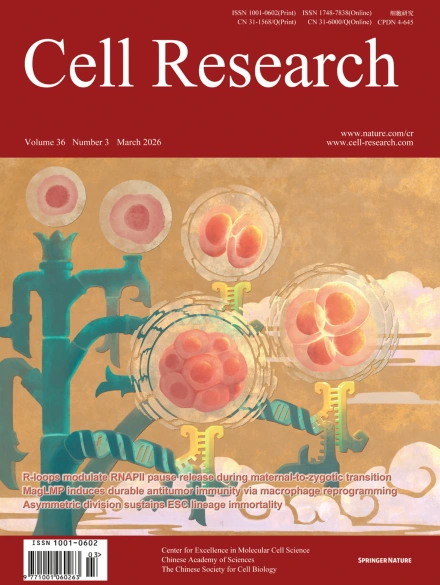
Volume 36, No 3, Mar 2026
ISSN: 1001-0602
EISSN: 1748-7838 2018
impact factor 17.848*
(Clarivate Analytics, 2019)
Volume 36 Issue 3, March 2026: 219-232
Asymmetric division in a two-cell-like state rejuvenates embryonic stem cells
Xinyi Wang1,2,† , Hong Fu2,3,† , Qingyang Sun2,3,4,† , Boyan Huang1,2,† , Zhe Xu1,2,† , Xuzhao Zhai2,5 , Chuncao Deng2,6 , Laru Peng1,2 , Mengdan Zhang1,2 , Tianran Peng1,2 , An Gong1,2 , Jiasui Liu1,2,8 , Zhengzhi Zou4 , Guangjin Pan7 , Jiekai Chen7 , Guangming Wu2 , Man Zhang1,2,* , Mingwei Min1,2,*
1GMU-GIBH Joint School of Life Sciences, The Guangdong-Hong Kong-Macao Joint Laboratory for Cell Fate Regulation and Diseases, Guangzhou Medical University, Guangzhou, Guangdong, ChinaA fundamental question in biology is whether all cells age. Embryonic stem cells (ESCs) defy the norm as rare normal cells capable of indefinite in vitro passage. However, the mechanisms underlying ESC lineage immortality remain unresolved. Using long-term live-cell imaging to follow the fates of single ESCs, we show that ESC lineage renewal is achieved through sporadic entry into a state characterized by the expression of two-cell embryo-specific markers. During this state, cells undergo asymmetric fate divisions, enriching accumulated DNA damage into one daughter lineage that is destined for elimination, while producing a second lineage that reverts to the pluripotent state. Importantly, the latter lineage exhibits signs of rejuvenation, including reduced DNA damage and enhanced chimeric efficiency. These findings underscore the crucial role of asymmetric cell division in maintaining the long-term health of the ESC lineage against mounting damage within individual cells and provide a potential model for studying cellular aging and rejuvenation in mammalian cells.
https://doi.org/10.1038/s41422-026-01221-z
